
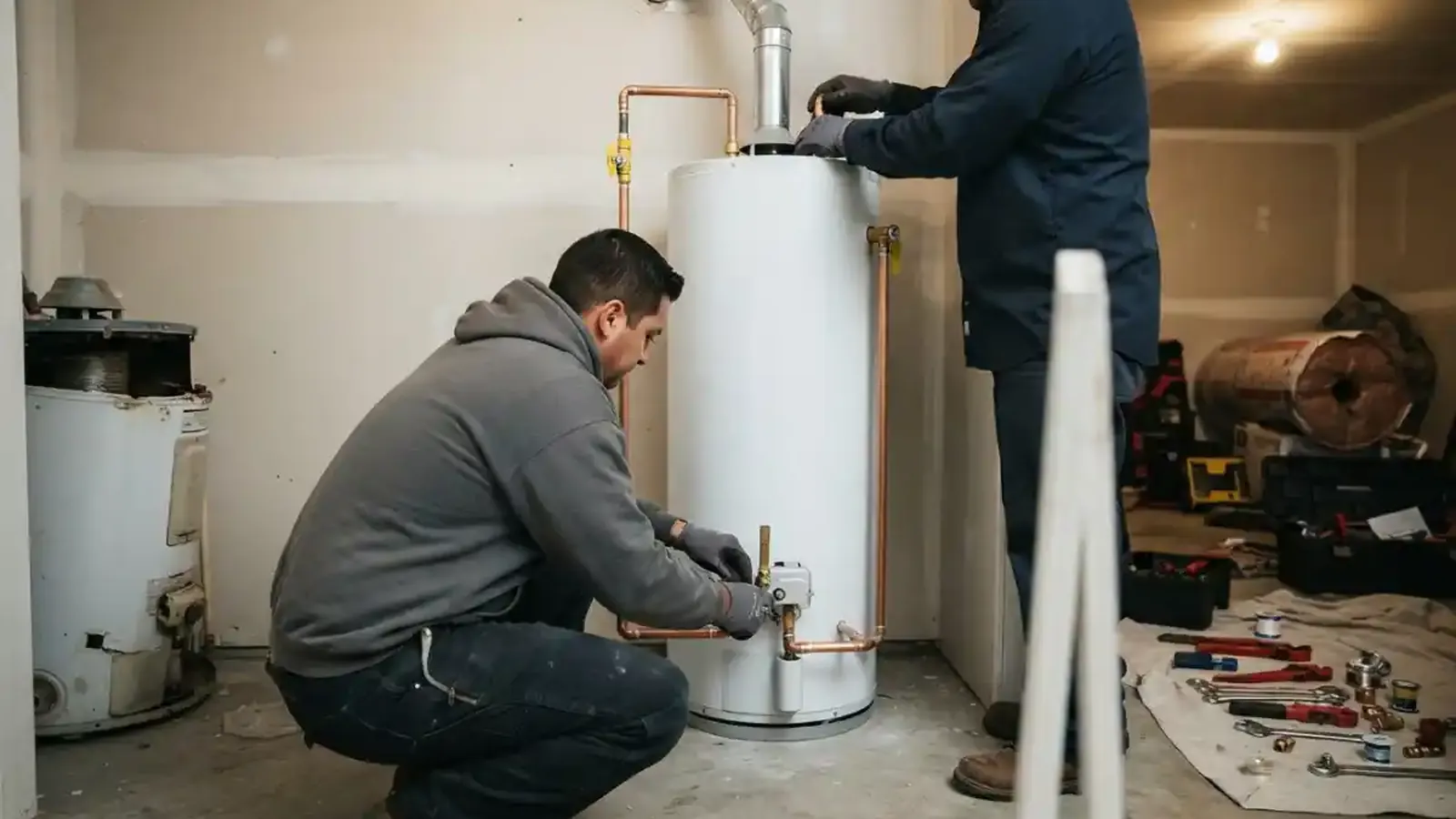
Emergency Water Heater Replacement in Silver Spring, PA
Water heater replacement means removing a failed or leaking tank and setting a new heater in its place, with fresh connections, venting and safety fittings.
We dispatch licensed plumbers 24/7 to Silver Spring, PA, and we will tell you straight when a leak means the tank is done.
Flooding from a failed tank: first steps
A tank that has let go can empty dozens of gallons onto a floor, so speed matters more than neatness. Call the 24/7 line once the water is under control, and ask for same-day or after-hours dispatch.
- Turn the cold supply valve above the tank to closed. If it spins freely or will not move, close the main valve where water enters the house.
- Cut power at the breaker for an electric tank, or set the gas control to off if the room smells normal.
- Attach a hose to the drain valve only after the water inside has cooled, and run it to a floor drain or outdoors.
- Mop standing water, set a fan on the floor and lift anything porous off the wet area.
- Write down the label details: capacity, fuel type and model number.
- Take photos of the tank and the wet area before cleanup.
When a water heater leak means replacement
A steel tank rusts from the inside out. Once the lining has failed, water works through the shell and appears at the bottom, down the side or under the jacket, and the metal cannot be patched in any lasting way.
Not every leak means a new heater. A loose supply connection, a failing drain valve or a relief valve passing water can be repaired, which is why our repair page covers how to trace each source. The deciding sign is moisture that returns after you dry the tank wall, or a bulging seam and rust trail running down the side.
A tank that leaks from the body is also a safety job, because water around a heater can reach wiring, a gas control or finished flooring. Shut it down and let a plumber look rather than waiting to see how bad it gets.
Replace or repair: how common situations compare
| Situation | Usual answer | Why |
|---|---|---|
| Water seeping from the tank body | Replace | The inner lining has failed and the shell is corroding |
| Drip at a pipe fitting above the tank | Repair | The tank is intact and the fitting can be redone |
| Relief valve running after each heat cycle | Repair first | Pressure or a failed expansion tank is often the cause |
| Rust-brown hot water from an old tank | Likely replace | Corrosion inside the tank is the usual source |
| Lukewarm water from a young tank | Repair | A single element or dip tube is cheaper to fix |
| Repeated repairs on a tank near a decade old | Weigh replacing | Typical tank life is limited, so each fix buys less |
No hot water from an older tank
A tank with no hot water is not always finished. An electric tank may just need an element, and a gas tank may need a thermocouple. Many tank heaters need replacing somewhere around a decade, and that typical figure is a reason to ask the question, not a rule.
Check the date code on the label. If the tank is old, shows rust at the base or has been repaired before, replacing it often makes better sense than paying for a part on a unit that may fail next.
How the swap works, start to finish
A like-for-like swap is routine for a plumber, but the order matters.
- Shut down and drain
Water, power or gas are shut off, the tank is drained and the old connections are disconnected.
- Haul out the old unit
The plumber carries the tank out, which is harder than it sounds on basement stairs.
- Set the new heater
It goes on a level surface, ideally over a drain pan, with the labels facing the room.
- Reconnect and add fittings
New flex connectors, a shutoff valve, a relief valve discharge pipe and an expansion tank when the system calls for one.
- Gas, power and venting
Gas lines are leak tested, electric wiring is checked and the flue is inspected for draft.
- Fill, purge and test
The tank fills, air is bled from the lines and the first heat cycle is watched before you are walked through the controls.
Choosing the replacement unit
Most emergency swaps keep the same fuel and size. If you have a day to think, the choices below are worth a conversation.
Same fuel, same size
The fastest route, since gas lines, vents and wiring already fit.
A different capacity
If you ran out of hot water often, a larger tank may help. If the house shrank, a smaller one saves energy.
A tankless option
Compact and endless in flow, but it needs venting, gas line capacity or electrical service to match. See tankless water heater service.
A planned upgrade
If the heater is not leaking yet, installation planning gives you room to compare fuel and venting without the rush.
What to have ready when you call
A few facts let the dispatcher send the right parts.
- Fuel type: gas, electric or a heat pump model on top of the tank.
- Capacity and model number from the label, or a photo of it.
- Where the heater sits: basement, closet, garage, attic or crawlspace.
- Whether the water is shut off and whether anything is still leaking.
- Stair width, a tight corner or a low ceiling on the path out.
- Your street, so we can route the nearest plumber.
Checking any plumber before you sign
Pennsylvania law requires home improvement contractors doing $5,000 or more of work in a year to register with the Attorney General and show the registration number on contracts and estimates. A written contract is required when work costs more than $500. A contractor may not demand payment before the contract is signed.
You can usually cancel a home improvement contract within three business days, except as the law provides for emergencies. Verify any contractor at attorneygeneral.gov or call 1-888-520-6680, and ask us the same questions.
Permits, old basements and the Lancaster side of the area
Permit rules vary, so ask the township zoning and permits office or its building code inspector whether a like-for-like swap needs paperwork, and ask your plumber who handles it. West Hempfield Township's permit form asks whether water and sewer are public or private, so know which you have.
Customers in Lancaster, about 5 to 7 miles from Silver Spring depending on ZIP, are served by the same line. Tell the dispatcher your ZIP and whether the heater is up a flight of stairs, because both affect how the crew plans.
What drives the price of a water heater replacement
The price depends on the unit you pick and the work around it. A same-fuel swap in an open basement is a simpler job than a new vent run in a crawlspace. Clear price before work starts means the plumber walks you through the number first.
Larger tanks and special models cost more, and changing fuel adds gas line or electrical work.
A flue that cannot be reused, or a move to a power vent, adds materials and labor.
New shutoffs, an expansion tank and a drain pan are separate parts that the plumber lists up front.
Narrow stairs, attic locations and old tank disposal change the labor.
Where paperwork is needed, handling it takes time, and water damage cleanup is its own scope.
Coverage varies by policy, so ask your insurer, and photograph the damaged heater, its label and any water-stained area before anything is removed.
Need a real number for the swap? Then call (717) 349-9373 and tell us the fuel, size and location.
Water Heater Replacement questions answered
Yes. Dispatch runs 24/7, so a failed tank at midnight or on a Sunday gets the same attention as a weekday call. Close the cold supply valve, cut power or set gas to off, and give the dispatcher your street and the fuel type so the right heater is on the truck.
It is a gamble. Small leaks tend to grow, and water near the burner or wiring is a hazard. If you must wait, shut the cold supply, switch off power or gas, and drain the tank so it cannot keep spilling.
It is an option, not a default. A heat pump model uses electricity to move heat and needs open air around it, a floor drain or condensate line, and the right breaker. We do not claim any rebate or incentive, so ask your utility and the maker directly.
Stop the source first, then remove water and wet porous materials quickly. Take photos for your insurer, and ask the plumber to note the cause on paper. Coverage varies by policy, so ask your insurer before you discard anything.
It depends on whether the plumber can reuse the venting, gas line and wiring. A same-fuel swap usually goes faster than one that changes fuel or moves the location. You get the plan on site before work begins.
An adult should be there to show the heater, approve the price and sign off on the finished work. The plumber needs a clear path and the means to shut water off at the main.
Where the rules in this water heater replacement guide come from
- According to the Pennsylvania Office of Attorney General's Home Improvement Consumer Protection Act brochure, contractors doing $5,000 or more of home improvement work in a year must register, and a written contract is required when work costs more than $500. Check any contractor at attorneygeneral.gov.
Call the 24/7 line about water heater replacement
Describe the problem to the dispatcher and a licensed plumber is sent when the work is urgent.