
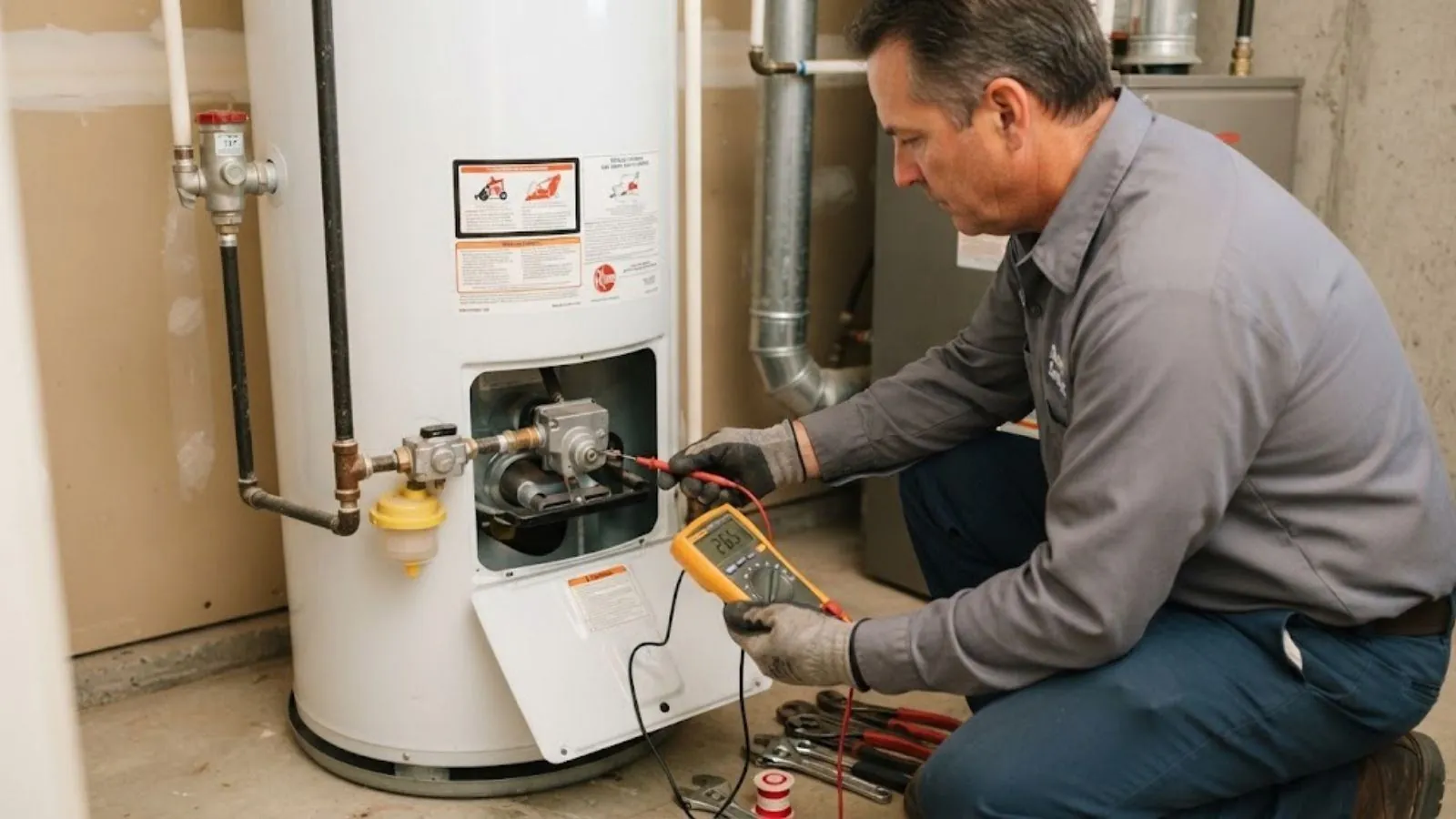
Emergency Water Heater Repair in Silver Spring, PA
Water heater repair is the work of finding out why a tank stopped heating, started leaking or began banging, then fixing the failed part or saying plainly that the tank is finished.
Our line sends licensed plumbers to Silver Spring, PA, from the Route 23 corridor to homes near Ironville Pike.
Leaking water heater right now: what to do while you wait
Call us at any hour. The line runs 24/7, and a plumber can be sent the same day or overnight when a tank is dripping steadily, wetting a finished basement or leaving the house cold. Until the plumber arrives, a few quick moves keep a small problem small.
- Switch the breaker off for an electric heater. On a gas heater, turn the control to its off setting only if you smell no gas.
- Close the cold water valve on the pipe feeding the top of the tank. A lever handle sits crosswise to the pipe when closed.
- Open one hot faucet at a sink so pressure bleeds off the lines.
- Lift boxes and stored items off the floor near the tank, and set a bucket under any drip.
- Stay clear of the relief valve discharge pipe, which can carry scalding water.
- Photograph the tank, its label and the wet floor before you mop up.
Water heater leak: finding where the water comes from
A wet floor beside the heater does not always mean the tank has failed. Condensation on a cold tank, a weeping pipe fitting above it and a relief valve that opens under pressure can all leave puddles, and each has a different fix. Dry the area with a towel, then watch where the first new bead of water forms.
Drips at the top usually trace to a loose supply connection or a worn fitting, which is a repair. Water from the relief valve or its discharge pipe points to excess pressure or temperature, sometimes from a waterlogged expansion tank or a thermostat set too high. Water seeping from the bottom or through the jacket means the steel tank has rusted through, and no part fixes that.
When the tank itself is the source, repair is the wrong word. Our page on replacing a failed tank explains the swap, and the plumber who comes out can confirm the source before you decide.
Signs a water heater needs a repair visit
- Rust-colored water from hot taps only, while cold water runs clear.
- Popping, rumbling or knocking from the tank each time it heats.
- Showers that go hot, then cold, then hot again.
- A pilot that keeps going out, or a burner flame with a lazy yellow tip.
- A breaker that trips every time the electric heater tries to run.
- Hot water that comes out far hotter than the setting, or steam at the relief valve pipe.
Symptom, likely cause and first step
| What you notice | Likely cause | First step |
|---|---|---|
| No hot water, electric tank | Tripped breaker, failed element or bad upper thermostat | Check the breaker, then book an element test |
| No hot water, gas tank | Pilot out, worn thermocouple or gas control fault | Rule out a gas smell first, then call |
| Lukewarm water only | One failed element, a cracked dip tube or a low setting | Leave the dial alone and ask for a test |
| Rumbling or popping | Sediment hardened on the tank bottom | Ask whether the tank is sound enough to flush |
| Rust-colored hot water | Corroding tank wall or old fittings | Schedule a visit soon, since the tank may be failing |
| Puddle under the heater | Loose fitting, relief valve or a breached tank | Shut off water and power, then trace the source |
No hot water: checks to make before you call
Start at the panel or the pilot window. On a gas model, see whether the stove or furnace still runs, which tells you if the gas supply is the issue. On an electric model, a tripped breaker is the cheapest fix, but do not press the reset button behind the access panel unless the power is off at the breaker.
Gas, electric and hybrid water heater repair
The three common tank types fail in different places, so the parts list changes with the fuel.
Gas heaters
Faults cluster around the pilot assembly, thermocouple, burner, gas control valve and flue draft. Any part that touches the gas path gets a leak check afterward, and a heater that backdrafts is a safety issue, not a comfort issue.
Electric heaters
Most have two elements and two thermostats, one upper and one lower. A single failure often leaves you with lukewarm water instead of none, so a meter test of each part is the honest way to find it.
Hybrid heat pump heaters
These add a compressor, fan, condensate drain and a backup element on top of the tank. Dirty air filters and clogged condensate lines cause many faults, and the display code points to the area. Follow the maker's manual for resets.
If you smell gas near the heater
Leave the building immediately and take everyone with you. Do not stop to flip a switch, light a flame or hunt for the source.
Once you are outside, call your gas utility or 911 from outside, and stay out until they say the house is clear. Call us afterward, because no technician should work on a heater in a home that smells of gas.
How a typical repair visit goes
- Questions and a safety look
The plumber asks what you saw and when it began, then checks the floor, the flue and the surrounding wall for water, scorching or rust trails.
- Isolate the heater
Power, gas and water to the unit are shut as needed so testing is safe.
- Test the suspects
Common methods include a meter check of elements and thermostats, a look at the pilot, thermocouple and burner, and an inspection of the relief valve and fittings.
- Explain the options
You hear what failed, whether a part fixes it and whether the tank condition points toward replacement, before any work starts.
- Repair and verify
The heater is brought back up, checked for leaks and tested for temperature at a tap.
Repair or replace: a fair rule of thumb
Many tank heaters need replacing somewhere around a decade, though that is a typical figure and not a promise for any one unit. A new element, thermostat or relief valve on a tank that is dry outside is usually worth doing. A tank that leaks through its body is not.
If repairs keep piling up, a tankless unit is one option to weigh. Read the date code on the tank label and mention it when you call.
Sediment, well water and the noise your tank makes
Silver Spring homes may be on public water or a private well, and the mix varies by street. Check your bill or ask your water utility for its annual water quality report, because minerals and grit settle at the bottom of a tank and cause rumbling, slow recovery and early wear.
If you have a well, test your tap. Grit caught in a faucet aerator is a hint that sediment is reaching the heater too. Homes near Lake Grubb Nature Park, along Ironville Pike and in Mountville, about 2 miles away, are all inside our dispatch zone, so give us your street when you call.
What affects the cost of water heater repair
A repair bill follows what failed and how hard it is to reach. A thermostat on an easy electric tank is a smaller job than a gas control valve in a tight closet. Clear price before work starts means you hear the number and the reason before the plumber opens a tool bag.
A common element or thermostat is quick to swap. A gas control valve or a hybrid compressor board is more involved and may need ordering.
A heater in an attic, crawlspace or cramped closet takes longer to reach and work around.
Seized shutoff valves or corroded fittings may need replacing, and you hear that before it is added.
On an old tank, a repair may buy little, so the plumber compares the repair price with the cost of replacing.
Coverage varies by policy, so ask your insurer, and photograph the heater, its label and any water damage before cleanup.
Want a real number for your heater? Then call (717) 349-9373 and describe what it is doing.
Water Heater Repair questions answered
Yes. The dispatch line answers 24/7, including overnight and on weekends, and a plumber can be sent the same day when one is available. Shut off the cold water and the power or gas control first, photograph the damage, and tell the dispatcher your street so the right plumber is routed to you.
Water at the bottom has three usual sources: a leaking drain valve, condensation, or a rusted-through tank. A drain valve is a small repair. If water keeps coming from under the jacket after you dry the area, the tank wall has likely failed, and replacement is the sensible route.
Many gas heaters print lighting steps on the label, and a pilot that went out once may be fine to relight. If you smell gas, leave first. If the pilot will not stay lit, the thermocouple or gas control is probably worn, and that needs a plumber.
No. The valve opens to protect the tank from excess pressure or heat, so a steady drip means something is wrong. It could be high supply pressure, a failed expansion tank or an overheating tank. Do not cap the pipe, because that defeats the safety device.
Partly. The tank, relief valve and plumbing connections are the same, but the heat pump section adds airflow, filter and condensate checks. Ask any company, including us, whether the technician who comes out works on hybrid units before you book.
Where the rules in this water heater repair guide come from
- According to the Pennsylvania Office of Attorney General's Home Improvement Consumer Protection Act brochure, contractors doing $5,000 or more of home improvement work in a year must register, and a written contract is required when work costs more than $500. Check any contractor at attorneygeneral.gov.
Call the 24/7 line about water heater repair
Describe the problem to the dispatcher and a licensed plumber is sent when the work is urgent.