
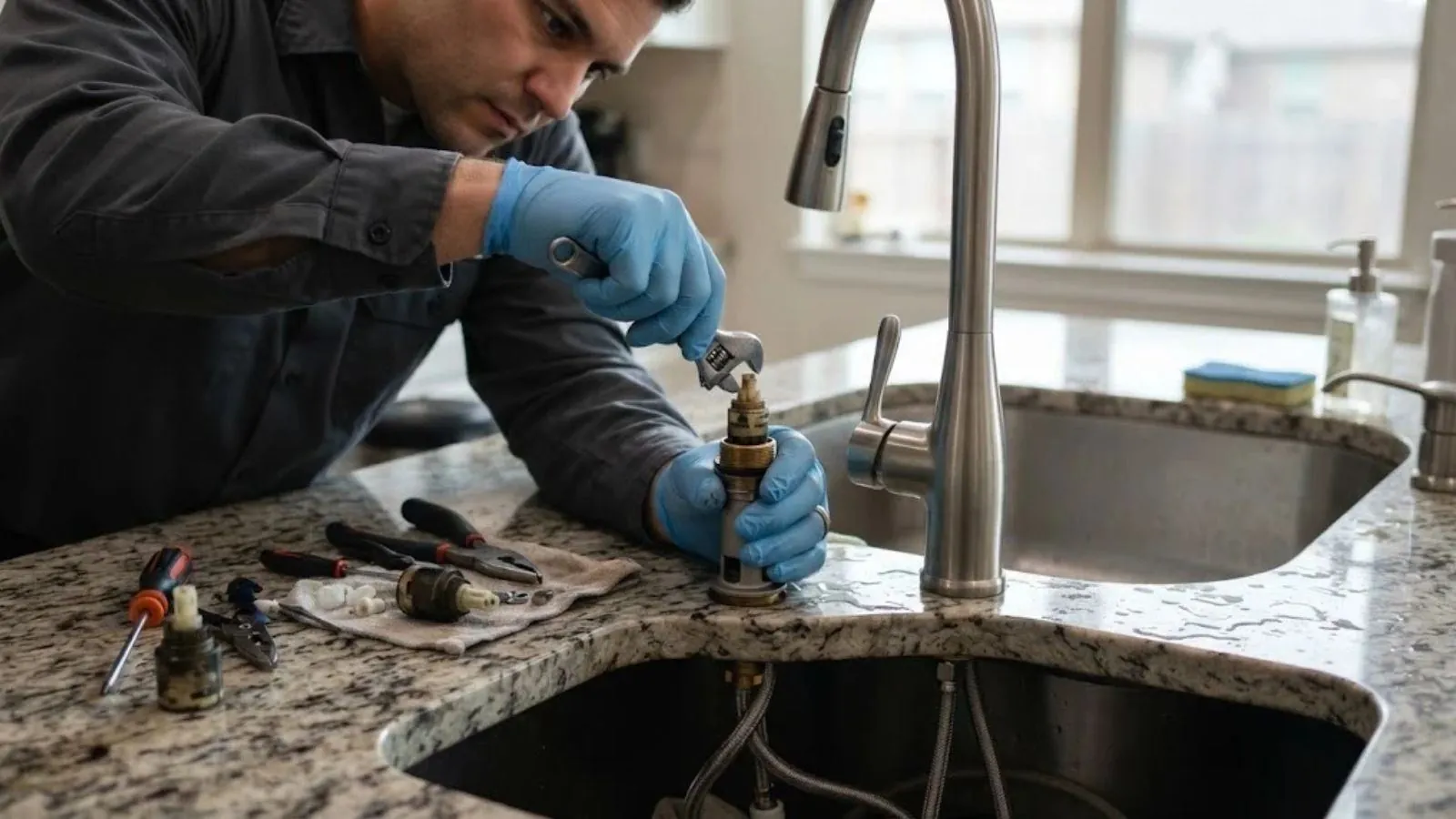
Emergency Faucet Repair in Silver Spring, PA
Faucet repair in Silver Spring, PA means fixing sink, tub and shower fixtures, the supply valves that feed them, and the traps and drains below. Call the 24/7 line when a valve will not close or a line is spraying. A steady drip can wait for a same-day visit when available.
Dripping, loose and weak faucets
Most faucet trouble comes from four internal designs: compression washers, ball valves, ceramic discs and cartridges. A drip from the spout means the part that closes the water has worn or collected grit. A leak around the base of the handle usually means a worn O-ring or a loose packing nut.
Weak flow is a separate complaint. Unscrew the aerator at the spout tip and look for grit or white crust. If a faucet is still weak with a clean aerator, the cause is often a partly closed supply valve or a clogged cartridge. The same goes for a toilet in the same bathroom that fills slowly, since a partly closed supply valve is the shared suspect.
What to do about a spraying supply line or a shutoff that will not close
This is the case for the 24/7 line. A braided supply line can burst at its crimp, and a corroded shutoff valve can snap off in your hand. Same-day and after-hours calls go to a licensed plumber, and what you do in the first few minutes decides how much cabinet and flooring survives.
If the water is coming from a pipe inside the wall, not from a fixture, the job is closer to burst pipe repair. Say so on the call.
- Go to the main water valve, usually near the meter or where the supply enters the basement, and turn it fully clockwise.
- Open a tap on the lowest floor to drain pressure from the house.
- Turn off power to any outlet or appliance the water is reaching.
- Empty the cabinet and sop up the base so water does not spread under flooring.
- Photograph the burst part, the wet cabinet and any stained ceiling below.
- Keep the failed part if you can, since it helps match the replacement.
Broken or stuck supply valves under the sink
Under every sink are two small shutoff valves, one hot and one cold. Older ones are multi-turn valves with a rubber washer, and the stem can seize after years of never being turned. Newer ones are quarter-turn ball valves that move a short distance between open and shut.
Do not force an old valve. Turning a stiff one can crack the stem or wipe out the packing, and then it leaks from the handle as well. Slow weeping at the stem often responds to a gentle tightening of the packing nut, but a valve that spins freely without stopping flow needs replacing, and sometimes the pipe behind it needs work too.
Which fixture, which symptom, which fix
| Fixture and symptom | Typical cause | Common repair |
|---|---|---|
| Kitchen spout drips from the tip | Worn cartridge or disc seat | Replace the cartridge or seats and springs |
| Water at the base of a pull-down faucet | Worn O-rings or a failing hose connection | Replace the seals, check the hose |
| Bath sink handle leaks when on | Cracked cartridge or loose packing | Swap the cartridge and tighten the nut |
| Shower runs hot and cold or drips from the head | Worn shower cartridge or mixing valve | Replace the cartridge behind the handle |
| Tub spout keeps trickling | Failed valve behind the wall, or a worn spout diverter | Replace the cartridge or the spout |
| Cabinet floor is damp, spout is dry | Weeping supply line or valve | Replace the line or the shutoff |
If the cabinet floor stays wet after you wipe it dry for a day, the source is almost never the spout.
Showers, tub spouts and handles that will not stop
A showerhead that drips after the handle is off is usually a worn cartridge, not the head itself. A shower valve sits behind the wall, so the work starts at the handle and trim plate. Access matters: some tubs have a panel on the far side, and some need a small opening cut in the wall.
Tub spouts fail in two ways. The diverter that sends water up to the shower can stick, and the spout can pull away from the wall and leak into the cavity behind it. A cracked tile or stained ceiling below a bathroom after months of a slow tub leak is a reason to ask for a moisture check along with the repair.
Sink traps and slow shower or tub drains
A P-trap is the curved pipe under a sink that holds a plug of water to block sewer gas. It also catches the jewelry and grease that fall down the drain. A loose slip nut or a cracked trap leaks only when the sink drains, so run the water and watch the joints.
Tub and shower drains usually clog with hair wrapped around the crossbar or stopper. A hair tool or drain strainer clears many of them. If both the sink and the tub drain slowly, or the problem returns within weeks, the clog sits deeper and falls under drain cleaning rather than fixture repair.
How the plumber works through a fixture leak
- Stop the water
The nearest shutoff is closed. If it will not hold, the main valve is used and the failed shutoff goes on the repair list.
- Identify the design
Brand and model, or the shape of the parts inside, decide which cartridge, seat or seal is needed.
- Open and inspect
The handle and trim come off. The plumber looks for scored seats, brittle O-rings and mineral crust.
- Repair or swap
Small parts are replaced when the body is sound. A pitted or cracked body means a new faucet.
- Pressure test
Water goes back on slowly, every joint is watched, and handles are cycled to catch a leak that only shows under pressure.
When replacing the whole faucet beats repairing it
- The body is pitted, cracked or corroded where the handle mounts.
- Parts are discontinued and the plumber cannot match the cartridge.
- The finish is flaking and the faucet leaks in more than one spot.
- The faucet has been repaired more than once for the same drip.
- You want a pull-down spout, touchless model or different hole spacing.
- A two-handle set needs several separate parts, and one new single-handle faucet may make more sense.
Test your tap, and mind the old valves
Hardness differs from one water supply to the next, so test your tap with a basic kit and ask your water utility for its annual water quality report. White crust on the aerator and showerhead is the signal to act on, since scale wears cartridges faster.
Columbia's streets were laid out long before modern plumbing, and many houses there mix old and renovated fixtures. If your valve looks original, a plumber serving Columbia will often suggest replacing the shutoffs while the faucet is already apart.
What drives the price of faucet and valve repair
A cartridge swap is a small repair, and a corroded valve that needs pipe work behind it is a different one. The plumber who comes out can usually tell you which you have once the handle is off. Clear price before work starts applies whether the visit is scheduled or after hours.
A bath sink, kitchen pull-down and shower valve each take different parts and different access.
A seized valve that must be replaced adds parts and labor, and may require cutting into supply tubing.
Shower valves behind tile cost more time than a bath sink in an open vanity.
Common cartridges are easy to source, and older or specialty ones can mean a second visit.
A cabinet base that swelled or a stained ceiling may need drying or another trade.
What your insurer covers varies by policy, so ask them, and photograph the damage first. A picture of the failed part and the wet cabinet carries more weight than a description.
Want a real number for your home? Then call (717) 349-9373 and describe the problem.
Faucet Repair questions answered
Yes. The line runs 24/7. A spraying supply line or a shutoff that will not close is the case to call about right away. Close the main valve first, then describe where the water is coming from.
That usually means a worn spot on the cartridge or disc, so it seals in some positions and not others. It is a repair part, not a plumbing disaster, and it tends to get worse slowly.
Sometimes. If you can turn off the water and pull the cartridge, matching it is manageable. Call a plumber if there is no access panel, the handle will not come off, or the shutoffs will not hold.
Stop forcing it, since a stuck stem can snap or leak. Close the main water valve for the house, and leave the repair to someone who can replace the valve and check the pipe behind it.
No. It is a drain problem, though we handle the fixture side too. Hair at the drain opening is a hand-clearing job, while a clog that returns in a few weeks usually needs line cleaning.
Often, yes, if both need work. Kitchen sink calls sometimes involve a leaking garbage disposal under the same faucet, so mention both when you call.
Where the rules in this faucet repair guide come from
- According to the Pennsylvania Office of Attorney General's Home Improvement Consumer Protection Act brochure, contractors doing $5,000 or more of home improvement work in a year must register, and a written contract is required when work costs more than $500. Check any contractor at attorneygeneral.gov.
Call the 24/7 line about faucet repair
Describe the problem to the dispatcher and a licensed plumber is sent when the work is urgent.