
Toilet Leaking at the Base in Silver Spring, PA
A toilet leaking at the base usually comes from a failed wax ring seal, a dripping supply connection or tank sweat, and a dry-paper test shows which. This guide for Silver Spring, PA homes covers how to find the source, what is safe to fix yourself, and when the floor needs a plumber.
Where the water at the base really comes from
Water around a toilet base has three common sources. The wax ring or flange seal can fail and let water out during a flush. A supply line, shutoff valve or tank bolt can drip and run down the outside of the bowl. Or humid air can condense on a cold tank and drip, which looks like a leak but is not one.
Each source leaves a different pattern, so the first job is a clean test, not a repair. Dry the toilet, the floor and the supply line completely. Then wrap dry toilet paper around the base, the valve and the line, and see which paper gets wet first.
Water that shows up only after a flush, mostly at the base, points at the seal. Wet paper at the valve while nobody is flushing points at the supply side.
A dry-paper test that finds the source
- Dry every surface
Wipe the bowl, tank, supply line, shutoff valve and floor until nothing is damp.
- Wrap tissue at three spots
Place a strip at the valve connection, one at the tank bolts and a ring of paper around the base.
- Wait before flushing
Leave it alone for a while and check the paper. Wet tissue at the valve or tank bolts means the leak is above the floor.
- Flush once and watch
If only the base paper turns wet, the seal under the bowl is the likely cause.
- Rule out the tank
Add food coloring to the tank water. Color in the bowl without a flush is a flapper problem, which is a different repair.
Where the water shows up and what it means
| Where you see it | Likely cause | First move |
|---|---|---|
| Pools at the base only after a flush | Worn or unseated wax ring, or a flange problem | Stop using the toilet, close the supply valve, plan a reset |
| Drips at the valve or line connection | Loose nut, worn washer or a failing supply line | Snug the nut a little, replace the line if it keeps weeping |
| Drops at the tank bolts | Worn bolt washers or tank gasket | Replace the washers or the tank kit |
| Damp over the whole tank, no drip points | Condensation from cold water and humid air | Dry it and watch again on a drier day |
| Toilet rocks and water seeps out | Loose closet bolts or a broken seal | Stop using it and reset the toilet |
| Soft floor or a stain on the ceiling below | A leak that has been running for a while | Stop and call for a plumber |
Caulk around the base can hide the leak path and trap water under the bowl, so do not use it as a fix.
The easy fix: swap the supply line
A braided supply line is the one toilet repair most homeowners can do safely. It only needs a working shutoff valve.
- Shut off the valve and empty the tank
Turn the wall valve clockwise until it stops, flush, and hold the handle to drain the tank.
- Swap the line
Unscrew both ends, set a bucket under the valve, and install a new braided line hand-tight plus a small extra turn.
- Reopen slowly and recheck
Open the valve, let the tank fill, and run dry tissue around both ends before you walk away.
Resetting the toilet with a new wax ring
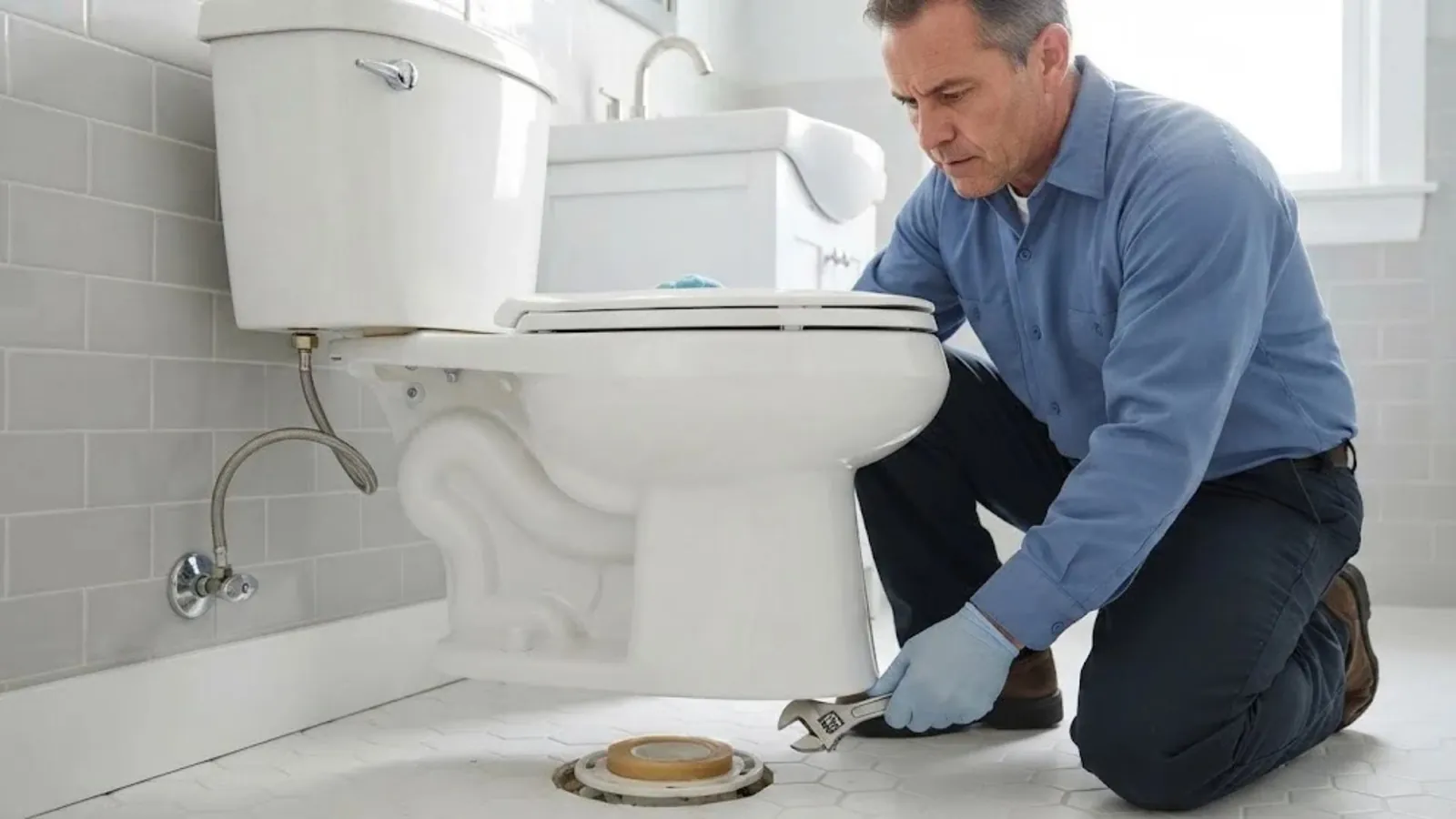
This job is reasonable for a handy person with a helper, because the bowl is heavy and awkward. Read this list, and stop if anything in the next section applies.
- Drain and disconnect
Close the valve, empty the tank and bowl, and disconnect the supply line.
- Lift the toilet straight up
Remove the nuts at the base, rock gently, and lift with a helper. Set it on towels and stuff a rag into the drain opening to hold back sewer gas.
- Inspect the flange
Look for cracks, rust, a loose ring, or a flange sitting below the floor surface.
- Scrape and seat a new ring
Remove the old wax, fit a new ring or a foam or rubber alternative, and lower the bowl straight down onto the bolts.
- Tighten in small turns
Alternate between the two nuts a little at a time. Overtightening can crack the porcelain.
- Reconnect and test
Reattach the line, refill the tank, flush a few times, and check the paper again.
When to stop and call a plumber
A cracked, rusted, loose or low flange is a job for toilet repair service, because the fix may need a repair ring or a new flange instead of just a new wax ring. The same goes for a toilet that still rocks after a reset or a bowl that will not sit flat.
A spongy floor or a stain on the ceiling below means water has been escaping for some time. Do not rock a toilet on a soft floor, and do not keep flushing. A leak detection visit can separate a toilet seal problem from a supply or drain leak inside the floor or wall.
Treat base water as dirty water
Water that escapes during a flush can carry waste. Wear gloves, keep children and pets out, and clean and dry the area with a disinfectant. Photograph the floor and any damage before cleanup, since coverage varies by policy, so ask your insurer.
If the toilet's own shutoff valve will not close or drips at the stem, close the home's main water valve instead and call.
What drives the cost of fixing a base leak
A supply line swap and a wax ring reset are quick compared with a flange repair or floor repair. What changes the work is the flange condition, how much of the subfloor is wet or soft, and whether the shutoff valve still closes. Some visits end with a new toilet when the bowl is cracked or the old model is hard to match.
Access matters too, since a tight bathroom with a tank against the wall takes more time to work around. Want a real number for your home? Then call (717) 349-9373 and describe what you see.
Silver Spring homeowners: older homes and what sits under the toilet
Homes around here range from recent builds to houses decades old. As general trade knowledge, older bathrooms can still have cast iron drain lines, and past remodels sometimes leave a flange at the wrong height or fixed to aging material. River boroughs founded in the 1700s, Columbia among them, hold a mix of old and renovated homes, so a flange that looks fine from above may still deserve a closer look.
No verified record of pipe types by street exists for Silver Spring, so the only way to know what is under your toilet is to look. Photograph the flange while the bowl is up, because that helps any plumber you call later. Our dispatch covers homes near Landisville to the northeast and Columbia to the southwest.
Local facts here come from the Wikipedia entry for Columbia and township pages. Statements about pipe age are general trade knowledge, not local records.
Quick answers to common questions
No. A seal that leaks on a flush sends dirty water into the floor, and the damage grows with every use. Close the supply valve, stop using that toilet, and dry the area until it is fixed.
Use the dry-paper test. Tissue that turns wet at the valve or tank means the leak is above the floor, while water that appears only at the base after a flush points at the seal.
Sometimes, if the toilet rocks and the nuts have loosened. Tighten a little at a time on alternate sides, since too much force cracks porcelain. A leak that returns afterward means the seal needs to be replaced.
There is no set lifespan. Rings usually fail because the toilet rocks, the floor moves, or the flange is low or damaged, so a ring can last for years or fail soon after a bad install.
Permit rules vary, so ask the township zoning and permits office or its building code inspector. The township's permit application does not name plumbing work, so a phone call is the safe way to check before a larger bathroom job.
Sources behind this guide
- According to the Pennsylvania Office of Attorney General's Home Improvement Consumer Protection Act brochure, contractors doing $5,000 or more of home improvement work in a year must register, and a written contract is required when work costs more than $500. Check any contractor at attorneygeneral.gov.
- West Hempfield Township website (westhempfield.org), for the township's permit application, building code official and septic pumping notice.
Want a plumber to look at it?
Call the line, describe what you see, and ask for a same-day appointment when available.