
How to Flush a Tankless Water Heater in Silver Spring, PA
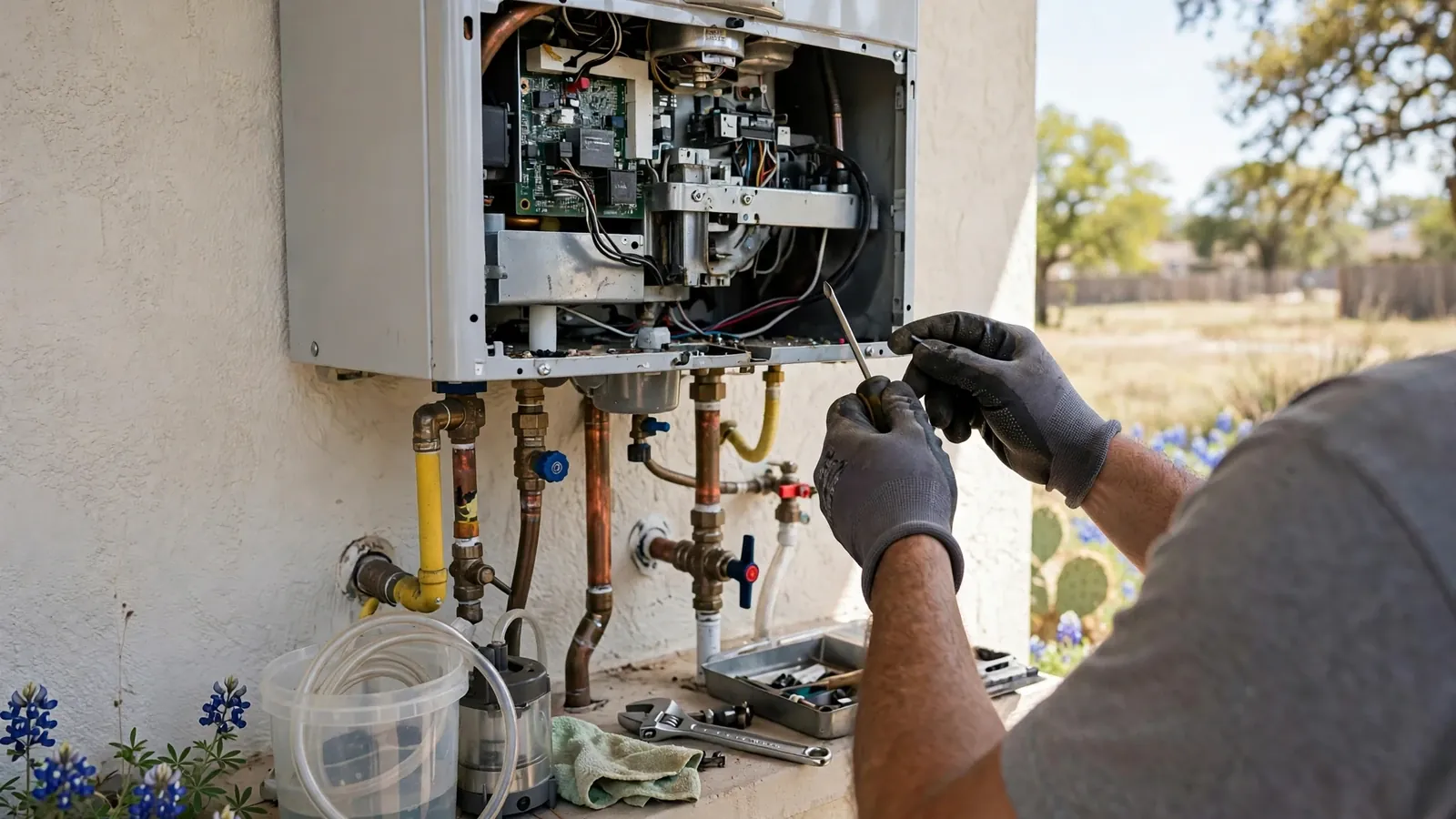
To flush a tankless water heater, you cut power and gas, close the isolation valves, then circulate descaling solution through the heat exchanger with a small pump and two hoses. This guide is for Silver Spring, PA homeowners and covers the tools, the steps, and the point where a plumber should take over.
The short answer: a flush is a descaling loop
A tankless flush pushes a mild acid through the unit's heat exchanger and back into a bucket. White vinegar is common, but your manual may name a specific descaler instead. The acid dissolves mineral scale on the hot surfaces, then you rinse with clean water and bring the unit back online.
Most households can do this with a small submersible pump, two hoses, a bucket and the fittings that match the service ports. It only works if the unit has isolation valves on the hot and cold lines. Without them, you cannot seal the unit off from the house, and the job starts with a plumber adding valves.
The right solution and the right schedule come from the maker's manual for your model. If the manual is gone, the model number on the unit's label will find it online.
Signs your tankless heater is asking for a flush
Scale is a slow problem, so the signs creep in. These are the common ones, and the table further down shows what else can cause each.
- Hot water takes longer to arrive, or the flow at hot taps feels weaker than the cold side.
- Rumbling, popping or crackling from the unit while it heats.
- Water temperature that swings during a shower even though you changed nothing.
- An error code on the display that your manual ties to flow, temperature or the heat exchanger.
- A white or tan crust on shower heads and faucet aerators, which hints that minerals are in your water.
What to gather before you start
- A small submersible pump and two hoses with fittings that fit your service valve ports.
- A clean bucket large enough to hold the pump and the solution.
- White vinegar or the descaler your manual approves for your model.
- The manual, plus the screwdriver or wrench needed to open the inlet filter.
- Towels, gloves and eye protection.
- A second bucket or a floor drain for the rinse water.
Flush steps, from power off to the last leak check
Read your manual first, because port layouts and gas valve locations differ by model. The order below is the general pattern.
- Power down
Switch off the unit's power or breaker, then close the gas valve to it. If you smell gas at any point, leave the building and call your gas utility or 911 from outside.
- Close the isolation valves
Shut the cold inlet and hot outlet valves. Open the small service ports with a bucket below to relieve the pressure.
- Build the loop
Connect one hose from the pump to the cold-side port and the other from the hot-side port back to the bucket. Pour in the solution and place the pump in the bucket.
- Circulate the solution
Run the pump for the time your manual gives. Watch every connection for drips and keep the return hose seated in the bucket.
- Rinse with clean water
Pull the hoses off the pump, open the cold supply and let clean water run through the unit into a bucket or drain until it runs clear.
- Clean the filter and restart
Rinse the inlet filter screen, close the ports, open the isolation valves, then restore gas and power. Run a hot tap until the air clears and check the display and the fittings for drips.
Symptom, likely cause and first move
A flush fixes scale, and only scale. Use this table to avoid descaling a unit that has a different problem.
| What you notice | Common cause | First move |
|---|---|---|
| Weak or slow hot water | Scale in the heat exchanger or debris on the inlet screen | Clean the screen, then flush as the manual directs |
| Short burst of cold water mid-shower | Very low flow, a setting, a sensor, or a plugged filter | Check the manual's minimum flow notes, clean the filter, call if it persists |
| Error code on the display | Flow, ignition, venting or temperature faults | Look the code up in the manual before touching anything |
| Rumbling or popping | Scale heating unevenly inside the exchanger | Schedule a flush soon |
| Water under or inside the cabinet | A failed fitting, a condensate problem, or a cracked part | Shut off power and water, then call |
| No hot water and no sign of life | Power, gas, venting or a safety lockout | Check the breaker and gas valve, then call |
None of the last three rows is a do-it-yourself flush problem. If the cause is not clear after a quick look, stopping early costs less than a second repair.
When to stop and call a plumber
Stop if the unit has no isolation valves, if anything smells like gas, or if a connection leaks that you cannot tighten by hand. A unit that shows the same error after a clean flush, drips from the cabinet or will not fire needs water heater repair from a licensed plumber, not a second round of vinegar.
If you would rather hand over the whole job, a tankless water heater service visit can cover the flush, the filter and a check of the error history. Some makers also ask for service records or professional service to keep a warranty intact. Read the warranty wording before you start, and keep dated photos of anything you do.
Worth knowing before you open a valve
Never circulate vinegar through a unit that still has power or gas connected. Acid fumes and splashes near live electronics or an ignition source are a hazard. Wear eye protection and keep the return hose in the bucket.
Check the manual before using vinegar at all. Some makers name a specific product, and an unapproved cleaner can damage seals or void a warranty.
What changes the cost of a professional flush
The main drivers are whether isolation valves already exist, how easy the unit is to reach, and how scaled the heat exchanger is. A unit in a tight closet or a crowded basement takes longer to hook up than one on an open wall. Venting, condensate lines and the model itself also affect the time on site.
If a plumber finds a worn part or a repeating error while there, the visit can turn into a repair, and that is priced separately. Want a real number for your home? Then call (717) 349-9373 and describe the unit.
Silver Spring homeowners: ask your water utility and test your tap
Scale builds at a pace set by your water, and no verified hardness figure for Silver Spring is available to quote here. Ask your water utility for its annual water quality report and compare it with what your own fixtures show. A crust on aerators is a quick visual clue that minerals are in the water.
Check your bill to see who supplies you. Columbia Water Company says it serves Columbia, Mountville and Marietta boroughs plus West Hempfield and several other townships, and Lancaster City Water also appears on the township website, so the supplier depends on the address. Homes on a private well should test their own water, since no utility report covers a well.
The result helps you pick a shorter or longer flush schedule within your maker's range. If you do need help, the Columbia plumber page and the Mountville plumber page show how our dispatch reaches the nearby towns.
Local facts here come from the Columbia Water Company PA PUC press release and the West Hempfield Township website.
Quick answers to common questions
Follow the schedule in the maker's manual for your model. Water with more dissolved minerals usually calls for more frequent service, which is why knowing your own water matters more than any general rule. If the manual is missing, look up the model number printed on the unit's label.
Not safely. Without valves, you cannot close the unit off from the house plumbing or connect hoses to its service ports. A plumber can add them, and after that, future flushes become a short home job.
Many manuals allow it, and some require a named descaler instead. Read yours first. Never mix vinegar with other cleaners, and rinse the unit with clean water until it runs clear.
The usual culprits are air in the lines, a filter that was not reseated, an isolation valve that is not fully open, or a gas valve left closed. Run a hot tap, recheck each valve, then reset the unit as the manual directs. If the same code returns, call for a repair visit.
No verified hardness figure is available for Silver Spring, so the answer is to check. Ask your water utility for its annual water quality report, test your tap, and look at your aerators. Well owners should test their own water. Then follow the manual's schedule, leaning toward the shorter end if scale shows up.
Sources behind this guide
- According to the Pennsylvania Office of Attorney General's Home Improvement Consumer Protection Act brochure, contractors doing $5,000 or more of home improvement work in a year must register, and a written contract is required when work costs more than $500. Check any contractor at attorneygeneral.gov.
- According to a Pennsylvania Public Utility Commission press release, Columbia Water Company serves Columbia, Mountville and Marietta boroughs plus West Hempfield, Rapho, East Donegal and Manor townships.
- West Hempfield Township website (westhempfield.org), for the township's permit application, building code official and septic pumping notice.
Want a plumber to look at it?
Call the line, describe what you see, and ask for a same-day appointment when available.